
Most people think racing careers are quite simple.
“If someone becomes a Formula 1 World Champion, it means he was always the best.”
“Always faster.”
“Always P1.”
Sounds logical.
But racing doesn’t really work like that.
Racing progression is far more complex than it looks.
And here’s the proof.
Between 2013 and 2014, Lando Norris and I raced each other almost every weekend.
Same tracks. Same championships. Same fights at the front.
And when both of us finished the race, the score was:
18 times I finished ahead of him.
7 times he finished ahead of me.

I remove DNFs on purpose.
If your engine breaks, you’re not slower.
If someone crashes into you, you didn’t drive worse.
So those races don’t really tell you who performed better.
Now, big DISCLAIMER:
This article is not to say I was the better driver; I’d be a fool to say so.
He was the one who made Formula 1.
He was the one who became F1 World Champion.
That’s reality.
(Even though we both became karting world champions, him in 2014 and me in 2013)
But the karting tracks told a slightly different story at the time…
Karting doesn’t predict the future….Early results don’t always define long-term career performance.
It only shows what happens in that moment with most kids with relatively equal opportunities (including budget, coaching & equipment).
So here I just want to go through those seasons race by race, explain what actually happened, and then explain why two drivers who fought each other every weekend can end up in completely different places later.
Just like Ayrton Senna and Teddy Fullerton.
Because in motorsport, results and careers are not always the same thing.
The First Time We Met
Our first proper head-to-head race was in October 2012.
WSK Final Cup.
Castelletto Di Branduzzo.
The final “BIG” WSK race of the year.
At that time, we were just two young drivers trying to prove something, even though I already had a full year and a bunch of WSK wins in my bag.
I finished P2 with Fastest Lap.
He finished P20.
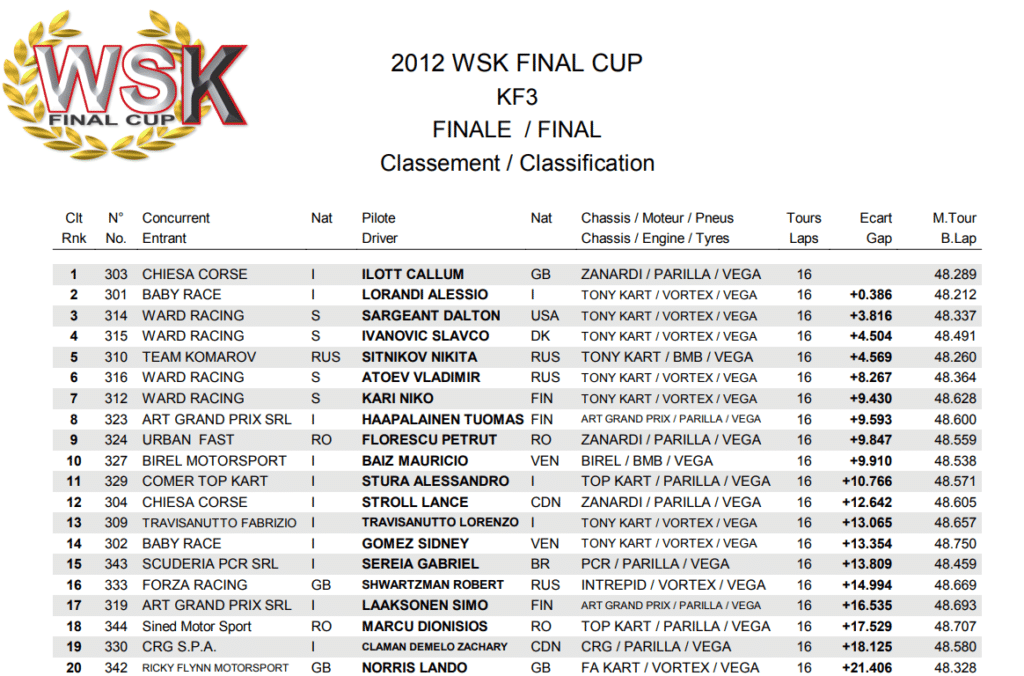
That was the very first time we shared the same result sheet.
Now, we all know one race doesn’t mean much.
One weekend can be luck.
Good setup.
Crash.
Traffic.
Weather.
But what I remember clearly is this:
He was very fast on a clean lap.
Very smooth.
Very precise.
But still quite fragile in the racecraft.
I was one year older.
And a lot more aggressive.
So quite a bit more “race ready” (to be fair).
That difference didn’t show much in qualy.
But it came out in fights (Racecraft).
And that was just the beginning.
Because from 2013 onward, we didn’t just race each other just once.
We raced each other pretty much every weekend.
And that’s when things started to become interesting.
2013: The Rivalry Becomes Real
2013 was a big year for both of us
We were literally the only two drivers to beat.
Almost every big weekend, one of us was winning.
We won a combined 11 races out of 19, a whopping 57% of the total, considering most races had 90+ drivers entering the race.
So the actual individual chances of winning on paper were about 1,1% each. (1 out of 90 given a random chance of winning).
Winter Cup — Starting on top
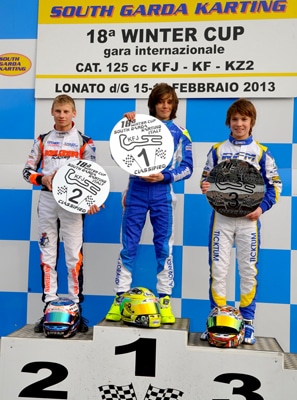
First big race of the season.
Packed grid. 100+ drivers.
6 or 7 qualifying heats.
I won. Everything. With margin.
He finished P5.
Good start for me, but more importantly, it showed the pattern that would repeat many times that year…
La Conca — Trading Wins
Next rounds at La Conca.
A WSK double header.
First race, WSK Super Master Series Round 1:
I won.
He finished P2.
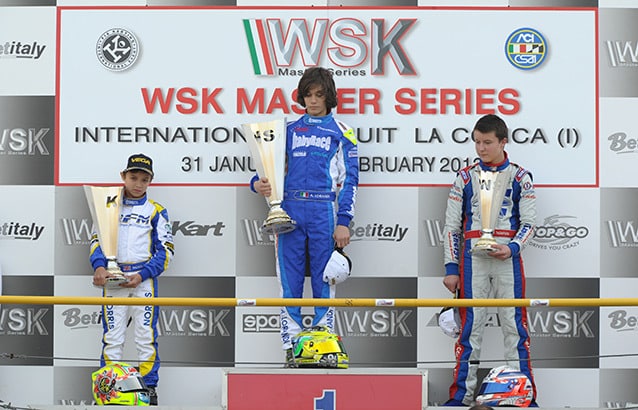
Second race, WSK Euro Series Series Round 1:
He won.
I finished P2.
That was his first major international win.
From that moment, it was clear: this wasn’t occasional anymore.
We were going to fight head-to-head all year.
We were each other’s nightmares.
And not gonna lie, we pushed each other so much all that season.
We didn’t want to see the other standing on the top step of the podium…
Sarno — The First Big Comeback
Super Master Series round 2.
I was supposed to start P1.
Engine starte failed in the formation lap.
I had to start last, from the pit lane, actually.
Finished P6 with a MEGA recovery. My pace was another level.
He finished P14 (I caught him up from starting in the pit lane).
That race mattered more than a normal podium.
Not for the result, but for what it proved.
That I could start from the pit lane and still finish ahead of him.
At least that had a strong impact to me, not sure about him.
Sarno Again — Redemption
Next Sarno race. Euro Series Round 3.
I won.
He finished P3 but won the Euro Series title.
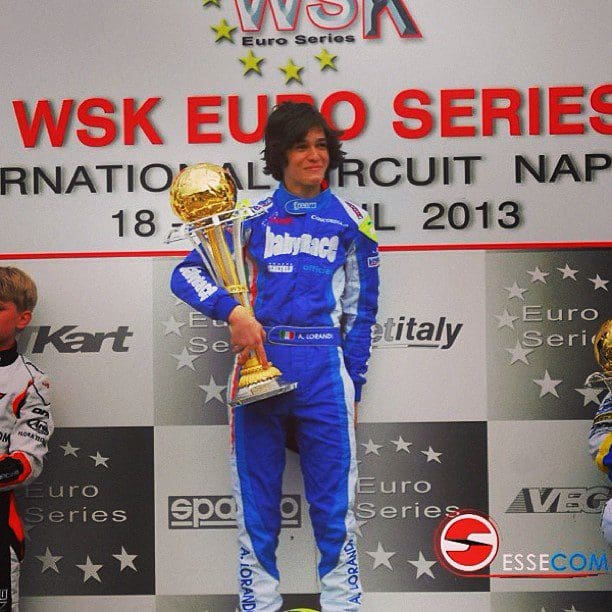
Damn it…
I was happy to have won the race, but so pissed off for the previous DNF at Zuera that cost me the title fight.
Precenicco — Triumph
Next round.
I won again.
He finished P6.
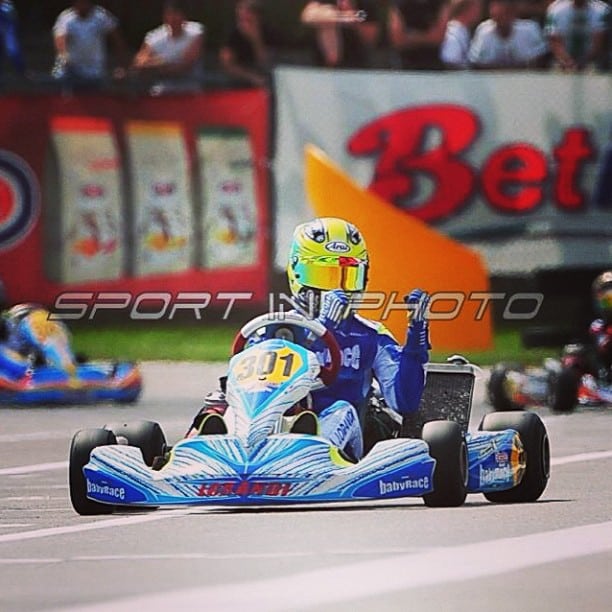
I clinched the WSK Super Master Series championship early, with one round to go.
Castelletto — Banging wheels
It was “just” an Italian championship round, where I was fighting for the lead, but that race was an unforgettable one, for both of us…
And one of the most fun fights of the season.
Pulling away at the early stages and then overtakes and switchbacks through the final laps.
I won race one. The main one.
He finished P2.
Reverse grid race:
I finished P5.
He finished P6.
Still finished ahead of him both times and extended my championship lead to the driver in P2.
European Championship — What Results Don’t Show
Aragon.
I finished P4.
Disqualified…underweight by like 100 grams.
He won.
On paper: big gap.
In reality: very little.
That’s racing.
Shit happens.
World Championship – The Big One
Sarno and Bahrain.
Two rounds that would decide who would become the world champion for that year in the FIA junior karting category.
Sarno:
I finished P2
He finished P22
After winning the prefianl and signing off in the lead till the last few laps, I then didn’t have the pace to match another driver, Pulcini, who seemed to have another gear on the straights…
Bahrain final:
He won
I finished P2
But overall, with a double P2…
I became WORLD CHAMPION!
And that’s probably the best way to describe that season.
We were both fast.
We were both winning races.
But over a full season, got me the biggest championships and race wins.
By the end of 2013 the head-to-head without DNFs was strongly in my favour.
11 (Me) vs 5 (Norris)
Not because I was always faster.
But because across many different situations, I finished ahead more often.
And that’s an important difference.
Because a single race can show potential pace.
But a full season shows the real average performance…
And performance across many races tells the real story.
2014 — New Category, New Problems
In 2014 everything changed for both of us.
New category.
KF2. Now known as OK Senior (Or simply OK).
Faster engines.
More power.
Front brakes.
Stronger drivers.
And most importantly: professionals.
In 2013 we were fighting mostly drivers our age.
In 2014 many drivers were basically full-time racers already that were 5 to 8 years older than us.
Guys like Felice Tiene, Karol Basz, Nicklas Nielsen, Pedro Hiltbrand, Tom Joyner…
They were not “kids trying to learn”.
They were specialists.
So suddenly the rivalry didn’t disappear —
but the context changed a lot.
Winter Cup — Straight Away
First race of the season.
Lonato.
New category debut for both of us.
I really didn’t knoe what to expect.
I wanted to win but I knew how hard it would have been…
But stil…I DID IT AGAIN
I WON IT!
Again.
For the second year in a row.
That was a huge feeling honestly, because the jump from junior to KF2 was big and you never really know where you stand.
He finished P34 but still made the final.
Right from the start I had a lot of pace compared to the rest of field that weekend.
Not just compared to him, compared to everyone.
Good sign.
It was a very special win because I’d matched Max Verstappen with his previous back to back win in 2012 and 2013 in the same 2 categories.
Now he was in Formula 3 instead.
La Conca — Still There
Champions Cup rounds.
First round:
I WON AGAIN!
He finished P9.
Second round:
I finished P3.
Couldn’t quite fight for the win — was missing a tenth of pace.
He didn’t even qualify.
I was so upset because I missed out on the title for a few points…
But stil.
At that moment I felt like:
ok, I adapted to the category quicker.
But the season was long.
And KF2 punishes small weaknesses more than juniors.
When Everything Gets Harder
From here on, the year got harder.
More crashes.
More chaos.
Less performance from my kart.
And a lot less predictable.
Sarno round — we both crash.
Castelletto — bad race for both.
You could be fast all weekend and lose everything in one corner.
That category was like that.
I finished P2 in the WSK Super Master Series, championship eventually, losing it out for a few points in the last round of La Conca.
He was way further back. like 12th overall.
But unlike 2013, neither of us was dominating anymore.
We were fighting a much tougher field.
European Championship — The Grip Arrived
Here is where an interesting pattern appears.
Grip level started deciding a lot.
I was taller. Way taller than him.
Minimum 30-35 cm.
Which means a much higher center of gravity…
In Low grip → advantage for me
In High grip → advantage for him
When grip was low or rain came, I could be very quick without pushing too much.
When grip was very high, I struggled more with hopping and 2 wheels, while he got extremely fast, just like an F1 car sitting on the ground with limited lateral roll.
So depending on the weekend, the pace between us shifted naturally.
This is something people underestimate a lot in karting.
Body size matters.
A lot.
The World Championship
Final race of the year.
I crash at the start.
Finish P21.
Still, the performance from my kart was far below the average of that year.
It was like I was going to war with a stick while others had AK-47.
I had no power all week long.
And the other teams brought some real engine upgrades that made the difference.
Lando had another gear.
And he won.
The only race he won that year…
But still: World Champion.
That’s motorsport.
And that race alone could make someone think the performance gap was huge in 2014.
But NO.
Across the season, the head-to-head still stayed in my favour.
In 2014:
6 – 2 without DNFs.
End of the Rivalry Period
Combine everything:
2012 = 1- 0
2013 = 11 – 5
2014 = 6 – 2
Total:
18 – 7
Two full seasons racing each other constantly.
Different tracks
Different conditions
Different championships
And the average stayed the same.
Always in my favor.
Not domination.
Not luck.
Just consistency…
What The Results Actually Mean (And What They Don’t)
Now comes the dangerous part.
Because numbers are powerful…
but easy to misunderstand.
18 – 7 doesn’t mean I was twice as good of a driver as him.
Or that I should have kept beating him consistently in the long run.
It only means one thing:
At that moment in time, in karting, I finished ahead 2x more often than he did.
I was probably more “ready” and I probably did a better job.
That’s it.
Nothing more.
Nothing less.
Unfortunately, Karting And Cars Are Not The Same Sport
People outside racing think motorsport is one ladder.
Win in karting → win in cars → reach Formula 1.
But in every step, the rules of the game change.
Karting rewards:
- Talent
- Feeling
- Track time
- Aggression
- Quick decisions
Cars reward:
- Unlimited budgets
- Testing mileage
- Engineering understanding
- Simulator work
- Data analysis
You don’t just “continue”.
You restart. From scratch.
Some drivers explode in cars.
Some drivers peak in karting.
Some need years to adapt.
Some run out of budget in the attemp.
So a karting rivalry is not an accurate prediction. (Unfortunately, for me) 🙁
The Biggest Difference After Karting
After karting, performance stops being only about driving.
It becomes about structure.
- Team selection
- Testing program
- Engineers talent
- “Special” equipment
- Simulator programs
- F1 Driver academies
- Management (or lack thereof)
- Coaching quality
All of this compounds.
Not in one race.
Over years.
Two drivers can start very close…
and after 5 seasons be very far apart.
Not because one suddenly forgot how to drive.
But because development amplifies performance.
Opportunity Multiplies Talent
This is the part young drivers misunderstand the most.
They think talent creates opportunities.
In reality, most often than not:
Opportunities grow talent.
- More laps → faster learning
- Better team → better feedback + better equipment
- More data → fewer mistakes
So improvement speed becomes different.
And after enough seasons, the gap looks pretty big.
Even if the starting point wasn’t.
Why I’m Saying This
Not to compare careers.
Not to say “what if”.
Not to say that I could have also been in F1….(Which I’m anyways sure I had the skills to)
And not to take anything away from what Lando achieved, because reaching Formula 1 and becoming world champion requires massive growth.
This is simply to prove something important:
Past karting performance doesn’t guarantee future results.
They are related.
But not identical.
The Real Takeaway
Karting showed that me and Lando were very close.
While the results slightly leaned my way.
But cars changed the environment.
And the path leaned the other way.
Both things can be true at the same time.
And that’s motorsport.
Racing requires planning, large budgets and great counselling.
Why?
Lando’s story is a clear example of that.
He got way more seat time than me. Which I’m sure didn’t hurt.
He had unlimited budget and could compete in multiple series at the same time. Which again didn’t hurt.
The financial backing gave him more options, better network and allowed him to build a brand (also thanks to his phenomenal management) and allowed him to be very marketable in the eyes of F1 teams like McLaren.
The planning of Lando’s career by his parents and his management was just flawless, and he became the driver he now is.
Nothing to take away from Lando’s merit, but I’m sure if every other driver had the exact same privileged opportunities, we would see a vastly different F1 grid right now…
What You Should Actually Learn From This Story
Let me tell you the real reason I wrote all of this.
Not to compare careers.
Not to say “I was better”.
Not to live in the past.
I wrote it because many young drivers believe something dangerous:
If I don’t win early, it’s over. (Talk about mental strength)
Or.
If I win in karting, I’ll for sure be an F1 driver.
That’s simply not true.
And I’m the living example of that.
Same as other drivers like Terry Fullerton or Mike Wilson.
Racing Is Not A Straight Line
You think racing is a ladder.
Win → move up → win → move up → Formula 1
But it’s not a straightforward ladder.
It’s more like the ocean.
Sometimes the wave pushes you forward.
Sometimes it pushes someone else.
And sometimes… you just need more time to learn how to surf.
Early Results Don’t Decide Your Future
At 13 or 14 years old:
- Bodies change
- Confidence changes
- Teams change
- Money changes
- Experience changes
Everything changes.
So one year you dominate.
Next year you struggle.
Then suddenly you improve again.
That’s normal.
The biggest mistake a driver can make is thinking:
“He beat me now, so he will always beat me.”
Or “He’s winning now, so he’ll be in F1 while I will not”
No.
You’re not finished yet.
You’re just unfinished.
What Actually Matters
Not your trophies.
Not your Instagram.
Not one championship.
What matters is this:
Do you improve every single race?
Do you improve every season?
Because careers are built on progression, not moments.
- Fast once = talent
- Fast often = skill
- Fast for years = professional
Focus On Controlling The Only Thing You Can
You can’t control:
- Engines
- Budgets
- Teams
- Politics
- Luck
You can control:
- How you train
- How you learn
- How you react after bad races
- How long you keep going
The drivers who last the longest…
are the ones who improve the longest.
The Truth About Talent
Talent is real.
But talent is only the starting point.
Hard work decides the end point.
And opportunity decides how fast you reach it.
That’s why two drivers can be equal at 14…
and completely different at 22.
Not because one “lost talent”.
Because life gave them different roads.
So Don’t Judge Your Career Too Early
If you’re 12, 14, 16…
You have no idea yet who you’ll become.
Neither do your rivals.
Neither do your parents.
Neither do your mechanics.
Racing careers are long stories.
And you’re still in chapter one.
The Only Goal You Should Have
Not: be better than him today
But: be better than yourself every DAY
If you do that long enough,
your path will take care of itself.
Maybe karting champion.
Maybe professional driver.
Maybe coach.
Maybe engineer.
Who knows what…
Motorsport rewards the ones who stay in it.
Final Thought
A result sheet shows a weekend.
A championship shows a season.
But a career shows the development plan put in action.
So don’t panic if today isn’t perfect.
Just keep improving.
Because in racing — and in life —
the final standings come much later than you think.