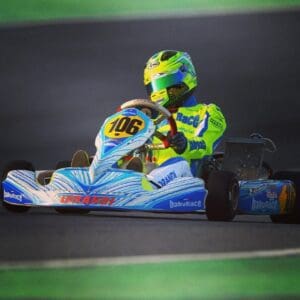
A Day in the Life of a Professional Go-Kart Driver
Professional kart drivers don't leave speed to chance. Here's exactly how we prepare, train, and improve every single day.

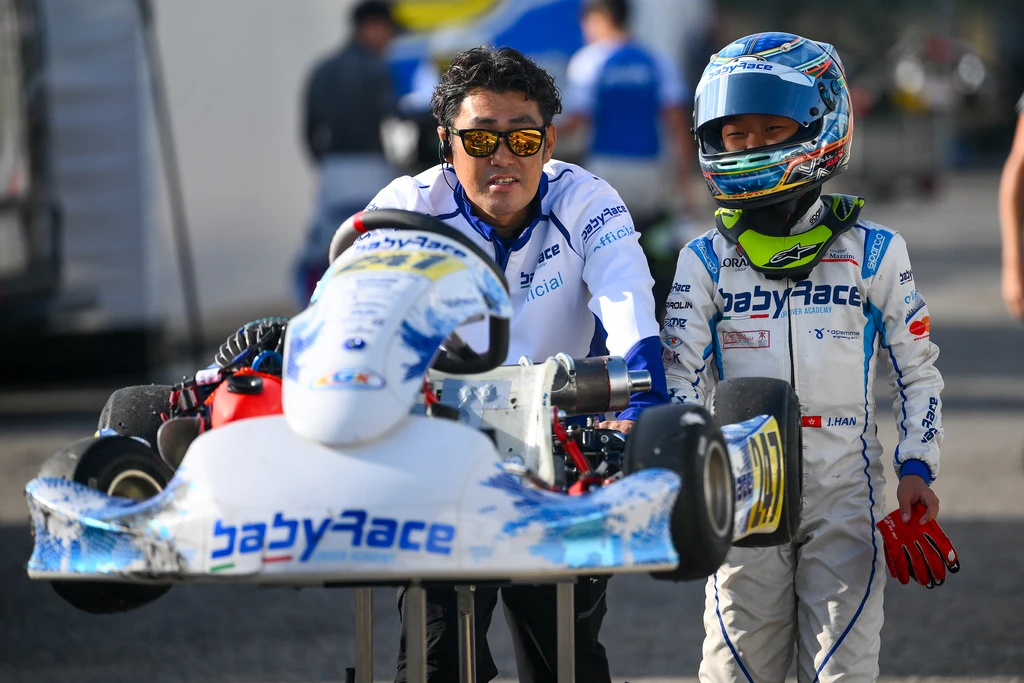
- A WSK race week starts on the Wednesday. Two practice days with four sessions of about 10 minutes, then warm-up, qualifying and heats from Friday, pre-final and final on Sunday.
- You drive a lot less than you think. About 40 laps on a WSK practice day if you use every minute, against roughly 100 a day in an X30 Italy race weekend with our kids at BabyRace.
- Drink from the moment you wake up. 2 to 3 litres a day, 3 to 4 when it is above 30 degrees. In KZ2 I drink up to 3 to 4 litres with mineral salts.
- No heavy lunch. A plate of pasta can cost you 1 to 2 tenths on a 50 second lap and wreck your consistency. Eat small, every 45 minutes or so.
- Wake your brain up before you drive. Music, rope skipping, reaction lights. Otherwise you lose the race on lap 1 while you are still asleep.
- Silence is a weapon. I do not talk to anyone from 30 minutes before a race, up to 45 for the big ones, other than pressures with my mechanic.
- After every session: data, video, mechanic. First question, how close was I to my theoretical time.
- Focus fades during the day. Phone away, chair next to the kart, a 30 minute nap at midday if you can.
- What does a race week look like for a professional kart driver?
- What does a kart driver do the night before a race?
- What does a kart driver do in the morning before the first session?
- How much water does a kart driver drink on a race day?
- What do kart drivers eat at the track?
- How do kart drivers get in the zone before a session?
- Why do drivers do reaction drills before getting in the kart?
- What does a driver do after every session?
- How does a driver work with the mechanic on a race day?
- How do you stay focused from the first session to the last?
- How is a race day different from a test day?
- What does a coaching day at BabyRace look like?
- Does every professional driver have the same routine?
- Frequently asked questions
People often ask me, “Alessio, what does a typical day look like for a professional kart driver?”
Well, it changes from one driver to another. Everyone has got his own routine. But for sure they have got lots of things in common.
So let me walk you through how I usually go about it on a race day, from the night before to the last session. What I did in my KF years with my mechanic Piero, what I do today in KZ2, and what I see every week with the drivers at BabyRace.
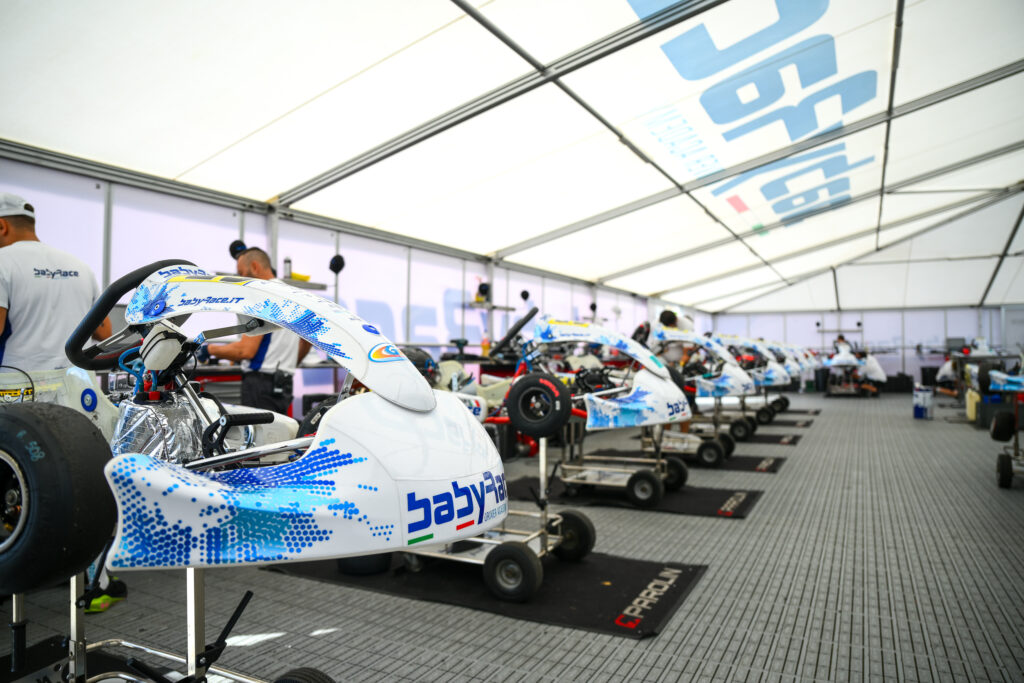
What does a race week look like for a professional kart driver?
Let me take a WSK round, because that is the one most of you want to race.
You cannot drive on the Monday and on the Tuesday of the racing week. Everybody is allowed to start from the Wednesday. So the testing you really need is the weekend before, at least the Saturday and the Sunday.
The Wednesday and the Thursday are practice days, with four sessions of about 10 minutes each. The Wednesday is optional, but most teams and drivers do both. On the Thursday, in the last two sessions, you already have the transponder, so you can see the lap times of the others.
On the Friday morning you have the warm-up and then right into qualifying. Then a qualifying heat in the last session of the day. That is when everything gets serious and the real weekend begins.
On the Saturday, warm-up again and more heats. On the Sunday, warm-up, the pre-final, and the final.
And here is the thing most people do not expect. If you do every single minute of the practice, you get maximum about 40 laps a day. On the Friday about 15 laps. On the Saturday about 20. On the Sunday, if you get to the final, again about 20.
So you do not go to a WSK to learn how to drive. You are supposed to know that already. You go there to sharpen your racecraft and bring home results. I wrote more about it in my guide to your first WSK podium.
What does a kart driver do the night before a race?
Boring things. And that is exactly the point.
Going to bed early. Prepping your bag before the race weekend. Packing your gear the night before. Becoming the best requires dozens of these small actions stacked on top of each other, and that is what a disciplined routine is.
Because think about it. If you are not disciplined enough to pack your gear the night before, if you do not analyze your data and your onboard every session, if you do not hydrate or take notes after you drive, how can you expect to show up and win on race day?
The other thing is sleep. If you are stressed, anticipating the race the next day, worried, you are not going to have a great night of sleep. And then automatically you are going to have a bad result the next day.
So I used to do breathing exercises a lot before going to bed, to relax myself. More on the exercise I use further down.
What does a kart driver do in the morning before the first session?
First things first, start drinking from the moment you wake up, even before breakfast. Do not wait until you are already in the paddock sweating in your suit.
My breakfast is something healthy and light to fuel me up, like fruits and nuts. It is super important to get that energy in early, especially if you have lots of back to back sessions on track.
Then I like to get my body moving. Some stretching, maybe a bit of mobility work, or light exercises to wake everything up. When I am driving in KZ2, I run on the track in the morning. And on a test day, when I head to the pit lane, I may do some basic running while warming up my shoulders.
Why does the body matter so much? Because in a professional kart, in very high grip with high power, you are driving at about 165 to 180 heartbeats per minute. That is almost like running at full capacity. You may wake up in the morning at 55 or 60 bpm, and then sitting on the grid, before you even start the engine, your heart rate is already way above average. Just from the adrenaline.
If you want to go deeper on the physical side, I explained it in endurance training for racing drivers.
How much water does a kart driver drink on a race day?
A lot more than most of you.
“You go so many times to the toilet mate,” a teammate once told me. “Yeah, because I drink way more water than you do,” I replied. He paused for a second. “That’s probably why my tongue feels dry when I’m driving…”
Aim for 2 to 3 litres of water a day, and on hot race weekends above 30 degrees, 3 to 4 litres is totally normal. Sip little and often, do not chug a full bottle at once. When I drive KZ2, I drink from my bottle filled with mineral salts, even up to 3 to 4 litres a day, and I go to the toilet minimum 4 to 5 times. That is also part of my routine.
Water. Not Coke, not Fanta, not Red Bull. I see drivers coming to our team with these habits and it is just junk before a session.
And you do not need to be in the Sahara to lose performance. It starts at 1 to 2 percent dehydration, which could be just half a litre missing. Your reaction time slows down, your concentration drops, you feel tired faster. And you probably do not even realise it. You just think you “had an off day”.
I believe 80 percent of the drivers I deal with are not fully hydrated. After our team meetings and data and video analysis, I always have to remind them to go drink two glasses of water. That is why I want each driver to have his own bottle, ideally 1 to 1.5 litres, so he can count how many times he has finished it.
What do kart drivers eat at the track?
Small things, often. And no heavy lunch.
Picture this. You did a really good job in the morning, you were among the fastest. Then lunch arrives, a giant plate of pasta bolognese, and your session is just 45 minutes after you finish it.
Two things happen. Your blood sugar peaks and you go into the so called “carbo coma”, sleepy, slower reflexes. And your digestion is still on its way. So for the first sessions after lunch you go around the corners with a full stomach, up to 2.5G of lateral force per corner, the rib protector squeezing your chest in a tight seat.
Compare your lap times before and after lunch. It will probably be 1 to 2 tenths over a 50 second lap. In my world, 1 to 2 tenths is the difference between pole and outside the top 10. And your consistency gets worse too.
So what do I do? Every single day on the track I eat a banana, mandarins, some dates (I love dates), some cashews, some chestnuts, a protein bar with nuts and some wholegrain crackers instead of lunch at noon. I eat every 45 minutes or so, and drink too. I never feel hungry.
Now, I am not a nutritionist, so do not quote me on the science. But I feel I have way more energy with a tiny bit of food repeatedly than with one big meal. You can’t find lap time with this, but you can surely lose some. More in how diet and hydration impact your karting.
How do kart drivers get in the zone before a session?
Everyone has his own way. This is mine.
Music, with noise cancelling headphones. It lights me up and it creates a bubble around me. Eminem, the Gladiator soundtrack, the Rocky songs. Most of the time I prefer soundtracks with very few lyrics, because lyrics can replay in my head while I drive. About 15 minutes before getting in the kart I take the headphones off, sip a bit of water, go to the toilet, do some reaction exercises, and then I jump in. I wrote a full piece on music before racing.
Silence. I simply do not talk to anyone from 30 minutes before a race, or even up to 45 minutes for big races, other than discussing pressures with my mechanic. I tell new people around me upfront, so they are warned.
Visualization. Before the first session, but really before pretty much any session, I go through the track in my head, corner by corner, braking points, lines, overtaking spots. In KZ2 I sit on a chair with closed eyes and headphones on, and I reproduce the hand and feet movements and the gearshifts, even the body movements from the lateral G force.
Breathing. Box breathing: 5 seconds in, hold 5, 5 seconds out, hold 5. Three cycles a minute. You can even do it in the kart on the pre-grid. In my KF years I would sit next to my kart, or on my rear tyre, on the pre-grid, sipping my bottle and visualizing the start. And if you only want the checklist for the minutes before a race, from rope jumping to cleaning your visor, here are my top 5 go kart pre-race routines.
Why do drivers do reaction drills before getting in the kart?
Because you don’t lose a race on lap 13. You lose it on the opening laps, when your brain is still in “sleep mode”.
Slow reactions. Lazy driving. One lap you brake here, one lap you brake there. Drivers pass you left and right and you wonder what just happened. By the time you wake up, the front runners are gone. I’ve seen this over and over again, on myself and on drivers I’ve worked with. I call it the “sleeping driver syndrome”.
So before qualifying, heats and finals (and free practice when I am not too lazy), I wake myself up on purpose:
- Rope skipping for a few minutes. It warms up your coordination and raises your heart rate. I picked this habit up late, in single seaters. I wish someone taught it to me sooner.
- Reaction lights, from brands like Blazepod or Metis. If there is one new habit you should add, this is it. The tennis ball drill does a similar job.
- A little ritual. Before I get in the kart I clap my hands twice with the gloves on and make a single jump. In the kart I pump the brakes a couple of times, then open my arms and move the rear tyres a bit.
Even a few minutes of this makes the difference. Your starts will feel sharper and your overtakes too. Here are the 5 ways I get in the zone.
What does a driver do after every session?
Once I’m done with the session, it is straight to data and video. Not the phone. Data and video.
I always want to know where I can improve. Maybe I’m braking too early, maybe the setup is not right, maybe I’m missing a bit of confidence somewhere.
These are the first questions I make my drivers go through:
- How close was I to my theoretical time? If you are five or six tenths off your own theoretical, do not talk about the engine. Go and fix that first.
- How consistent was I? 0.1 seconds of average deviation from your fastest lap is really good. 0.6 is a nightmare.
- How many laps did it take me to get to my fastest lap? If the race is 15 laps and you find your pace on lap 13, the race is gone.
Then you sit down with your mechanic, or in your case your coach, and you go through everything: lines, engine, tyre grip, whatever it takes to shave off those last couple of tenths.
And look at the tyres. Piero would show me my tyres after the sessions, explaining how each axle used them differently. Then he told me to go and look at the competitors’ tyres too, to see if they had pushed too hard in the heats.
How does a driver work with the mechanic on a race day?
Your mechanic doesn’t just tune the kart. He tunes the driver.
In my KF years I would sit next to my kart on my own chair, always discussing with Piero how to improve the setup, and hearing from him where I was faster or slower than the others, based on his splits. We discussed my plan for the start and the first laps, when to attack and where. In the wet, what lines the other drivers were taking.
We didn’t talk that much about setup. Mainly camber, caster, axle and tyre pressures. We got to a point where I would say “Il davanti mi spinge in uscita”, the front pushes me on exit, and we both knew we had to remove some negative camber.
From the mechanic’s ladder he had two signs he used the most. The “Ok” sign: keep pushing the same, the gap is growing. And the index finger: push to the maximum. That one was to me like red to a bull.
He also made me drink more water, take care of my helmet and clean my side pods at the end of the day. Clean the kart, clean the helmet and visor every session, show up on time. That is how you earn his respect. Read more on the driver and mechanic relationship.
How do you stay focused from the first session to the last?
Most drivers start the day very focused. They have breakfast, leave the hotel, arrive at the paddock with music on, pumped. What I notice with many drivers at BabyRace is that the focus gets smaller and smaller during the day, distractions creep in, and the track performance fades with it.
So you have to build it on purpose:
- The phone. Airplane mode with only Bluetooth on for your headphones. I used to leave my phone in the hotel. Try it one day and magically you’ll have all the time you need to analyze everything.
- A chair next to your kart. Grab it, sit there, review your data and your onboard, listen to your mechanic.
- A nap. If you feel tired at midday, find a quiet place and have a quick nap for like 30 minutes. It is regenerating. I take it whenever I have the chance.
- Teammates. They are the main distraction, honestly. When I put my headphones on, people know Alessio is trying to focus and they stop talking to me.
And know when you are at your best. On practice days I see the sweet spot for lap times at the end of the morning for most drivers, because in the afternoon they get tired. So if you want to go on new tyres, better at like 11 a.m. than at 3 p.m. I wrote more on maintaining focus during a race day.
How is a race day different from a test day?
On a test day you should always have a goal. Braking confidence, a setup direction, low grip, fitness. Driving empty laps without knowing what you are working on is a huge crime. Here is how to make the most of a practice day.
On a race weekend the goal changes. You go there to max out the driver you already are, by being as focused as possible every session and finding the last bits of lap time through data and onboard. The goal is to arrive on the grid on that Friday morning as the most prepared driver of the whole paddock.
And you drive the heats differently. I learned it the hard way at the WSK Master Series round 1 at La Conca, back in my KF years. I crashed in 2 heats out of 4 and set the fastest lap in the other 2. In the final I crashed at lap 7 of 16 with the fastest lap of the race. Piero told me in Italian that I had to become a “ragioniere”, someone who calculates.
So the heats became a means to an end for the pre-final, and the pre-final a setup for the only race that counts, the final. In WSK the heat points go the other way round: P1 scores zero, P2 five, P3 eight. You want as few as possible, so you don’t throw them away for a silly move from P4 to P3 in the last corner.
What does a coaching day at BabyRace look like?
Very different from a WSK day, and that is on purpose.
In a summer camp the kids do about 100 to 120 laps a day, so about 500 to 600 laps over five days. In an X30 Italy race weekend they get to roughly 100 laps a day on average. That is three times what you get at a WSK, where you are lucky with 30 to 35 laps a day. More laps, more learning, and racecraft with less pressure.
At an ACI Italian championship race it is the other way round. About 30 laps on the first practice day, then 20 to 25 laps max on the race days. In a whole four day race you will not make 100 laps. So between the sessions it is team meetings, data and video analysis. And then me reminding everyone to go drink two glasses of water.
The other thing I do as a coach is make sure a driver is ready before he races. If a kid has just started and he is three seconds off the pace, it doesn’t make sense to get him to race right away. Better more training first. And I don’t push anyone into a WSK before he is ready, even though it is against my interest, because it becomes a confidence breaker. If you want the full picture of the categories, read the karting ladder from 6 to 16.
Does every professional driver have the same routine?
No. No two drivers are the same.
Some prefer quiet time, others hype themselves up with music. Charles Leclerc, my teammate in Formula 3 in 2015, listened to music before driving. Some drivers are so tense that a joke with the mechanic on the grid helps them. Some need calming piano or violin music. I mostly go for high beats, but I like piano songs too when I need to calm down.
And my own routine changed too. In karting I sat next to my kart and studied my rivals. In Formula 3 I added music with noise cancelling headphones, onboard videos of my teammates, rope skipping and breathing. In KZ2 I added the chair with closed eyes, the run on the track in the morning and the reaction lights.
But I did not do these things because of the theory. They just happened, and I figured out over the years what worked for me. So pick some of these, make them yours, stay consistent, and tweak as you go. If you are just starting out, start with the driving fundamentals and these tips for first time drivers, and the braking tips after that. More of my stories are in the Extra guides.
Frequently asked questions
How many laps does a kart driver do in a day at a WSK race?
On the Wednesday and Thursday practice days there are four sessions of about 10 minutes, so about 40 laps maximum if you use every minute. On the Friday about 15 laps, on the Saturday about 20, and on the Sunday about 20 if you make the final.
How much water should a kart driver drink on a race day?
2 to 3 litres a day, starting before breakfast, and 3 to 4 litres on race weekends above 30 degrees. Sip little and often from your own bottle so you can count how many times you finish it.
Should kart drivers eat lunch at the track?
Not a heavy one. A big plate of pasta 45 minutes before a session can cost 1 to 2 tenths on a 50 second lap and makes your lap times less consistent. Eat small things like fruit, nuts and crackers every 45 minutes or so instead.
When should you stop listening to music before a session?
I take my headphones off about 15 minutes before getting in the kart. Then I sip some water, go to the toilet and do some reaction exercises before driving.
What is the first thing to check after a karting session?
How close you were to your theoretical time. Then how consistent you were, and how many laps it took you to reach your fastest lap.
If you want this routine built around you, with your driving in it, that is what I teach in the 6 months transformation. And if you just want me to look at one of your sessions, send me your onboard for an onboard review.
Send your onboard footage. Alessio reviews it corner-by-corner and tells you exactly what's costing you time, and how to fix it. Back within 48 hours.
Get My Onboard Reviewed → Reviewed personally by a CIK FIA World Champion, never an assistant.I promise I'll not spam you with repurposed shitty AI content but real experiences that only I, Alessio Lorandi, experienced. Written in my funny English-Italian tone of voice 😂
Alessio Lorandi is the former CIK FIA World Junior Champion, winning against Lando Norris in 2013 & F3 multiple race winner. He's helped 200+ karting drivers worldwide get faster & win WSK titles with BabyRace Driver Academy & now through Senndit, his online karting coaching platform.