Rental Karting vs Owner Karting Explained
Rental karts get you started. Owner karts make you fast. Here's why the jump matters.

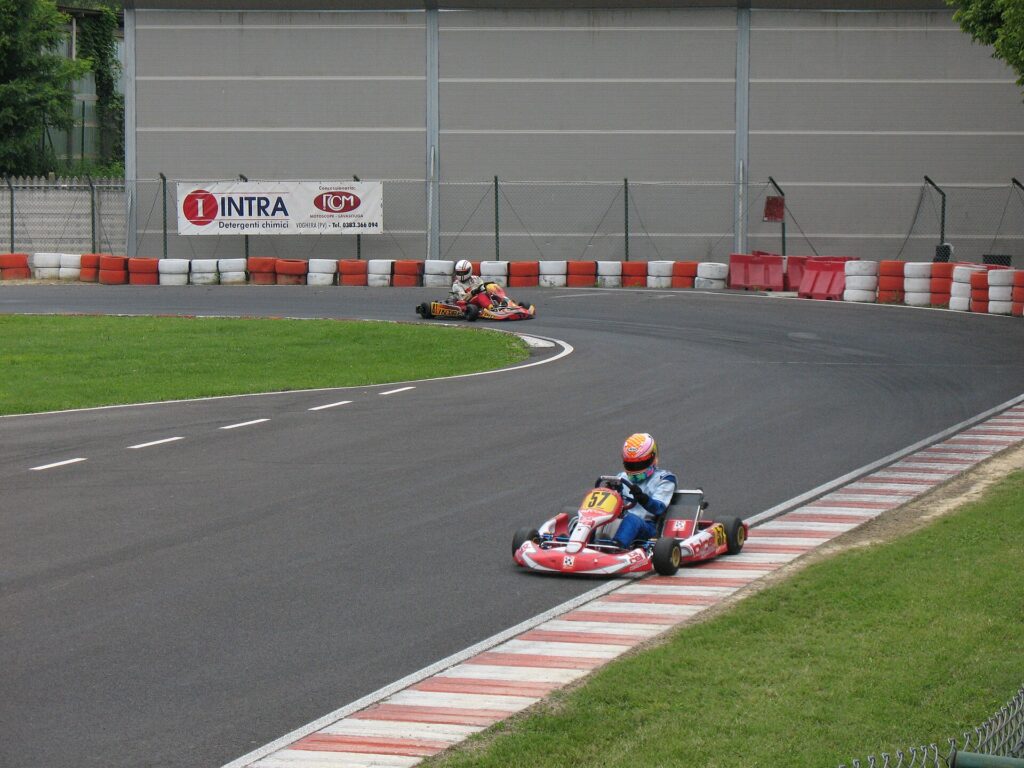
- One is not better than the other. Rental karting is the entry level, affordable way in. Owner karting is the more professional, more expensive league.
- The skills carry over. Racing lines, braking late and hard, and smooth steering are the same in a rental kart and in a racing kart.
- The gap is about 20 seconds a lap. At South Garda Karting in Lonato, 1,200 meters, senior karts lap in 46 to 47 seconds. A rental kart would be at least 20 seconds slower.
- Braking is what changes the most. A rental kart goes from 50 km/h to 35 km/h for a hairpin. A racing kart goes from 130 km/h to 50 km/h.
- Move when you win in rentals and keep wanting more. Consistently winning or setting very fast lap times, and always wishing for a faster kart, is the moment.
- Expect 2,000 to 4,000 euros for a first kart with its engine. In rentals you pay about 25 euros for 15 minutes and nothing else.
- The cost people do not expect is the mechanic. Between 200 and 250 euros per day. New tires are about 250 euros a set, used ones about 50.
- Keep driving rentals after you own a kart. Indoor rental karting is a good add-on for precision and racecraft, not a replacement for testing.
- What is the difference between rental karting and owner karting?
- What skills can you realistically learn in rental karting?
- When does rental karting stop helping you progress?
- What changes in your driving technique in an owner kart?
- How much faster is a racing kart than a rental kart?
- What do people misunderstand about racing karts?
- What kind of driver should stay in rentals longer?
- What kind of driver should move early to owner karting?
- How much more does owner karting cost than rental karting?
- What hidden costs exist in owner karting that people don’t expect?
- If your budget is limited, where should the money go first?
- Do you have to start in rental karts before buying your own kart?
- Should you still drive rental karts once you own a kart?
- Rental or owner: which one is right for you?
- Frequently asked questions
If someone came up to me and asked what the major differences are between rental karting and owner karting, I would tell them the differences are pretty big.
You normally start in rental karting and then transition to owner karting. But one is not better than the other. They are both very fun and very competitive environments.
So let me go through what is different, when it makes sense to move, and what changes for you and for your wallet when you do.
What is the difference between rental karting and owner karting?
Rental karting is the entry level, affordable way to get into karting. Owner karting is the more professional, more expensive league. It has more power, more G-forces and, in a way, more fun. And it comes at a much higher cost.
| Rental karting | Owner karting | |
|---|---|---|
| What it is | Entry level, affordable | Professional, more expensive |
| What you pay to drive | About 25 euros for 15 minutes | 2,000 to 4,000 euros for a first kart with engine, then track tickets, fuel, tires, maintenance |
| Equipment | The track provides everything | Your own helmet, rib protector, race suit, boots and gloves |
| Top speed | Up to about 75 km/h | 135 to 140 km/h for juniors and seniors at Lonato |
| Weight and power | Quite heavy, not that powerful | About 150 kilos including the driver, 40 to 50 horsepower |
| G-forces | Not that high | Up to 2.5 G laterally in the corners |
| Lap at South Garda Karting, Lonato (1,200 meters) | At least 20 seconds slower | 46 to 47 seconds with senior karts |
Because rental karting is the entry level version, it is a lot more reachable for the average driver. You go to a local rental track, indoor or outdoor, and you just show up. In the US there are the very famous K1 Speed venues, in the UK there is TeamSport, and there are plenty of other brands.
You can sign up for races if you wish, or you just drive with friends, organize a corporate event or a birthday party.
People choose owner karting for fun too. But the adrenaline is on another level. The speeds are higher and the feeling is almost like a mini Formula One. It is one of the most thrilling things you will do in your life.
What skills can you realistically learn in rental karting?
A lot of the skills you will need for professional karting, and later for racing cars like GTs and formulas.
The first one is racing lines. The lines you learn in a rental kart are the same you use on a racetrack.
On indoor tracks you are normally dealing with barriers. On outdoor rental tracks you are driving the same tracks you would drive with a professional owner kart.
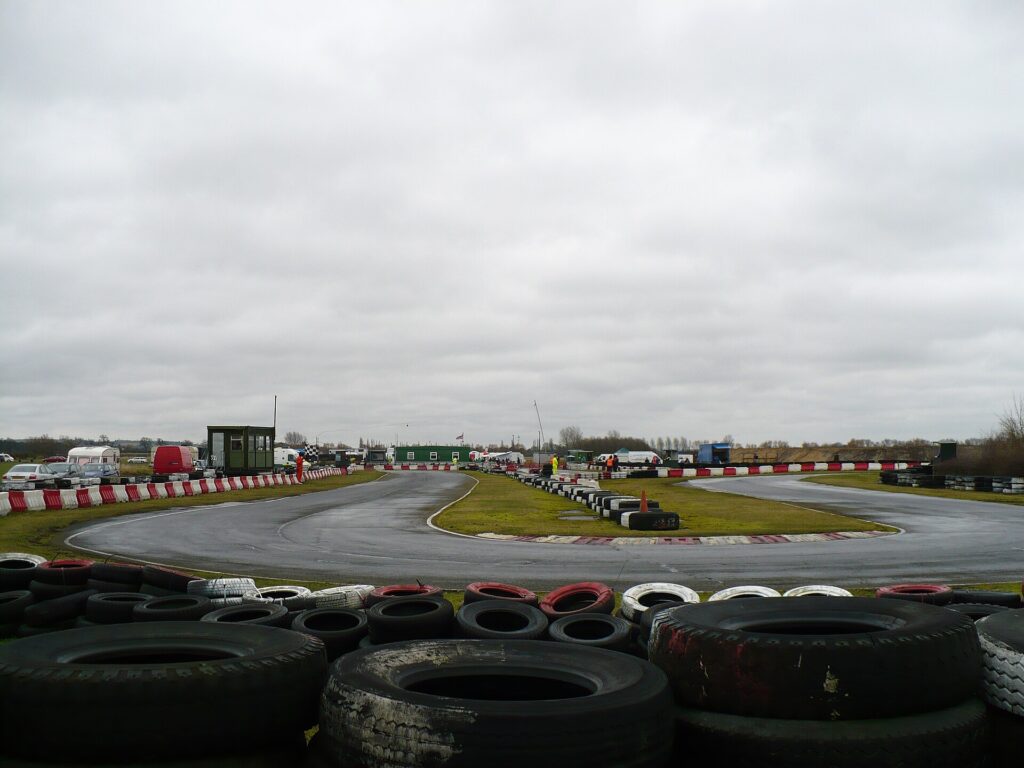
So you will deal with apexes, and you will deal with kerbs, which you have to use to go faster. Not the apex kerbs most of the times. The entry and exit kerbs, to make the corner wider.
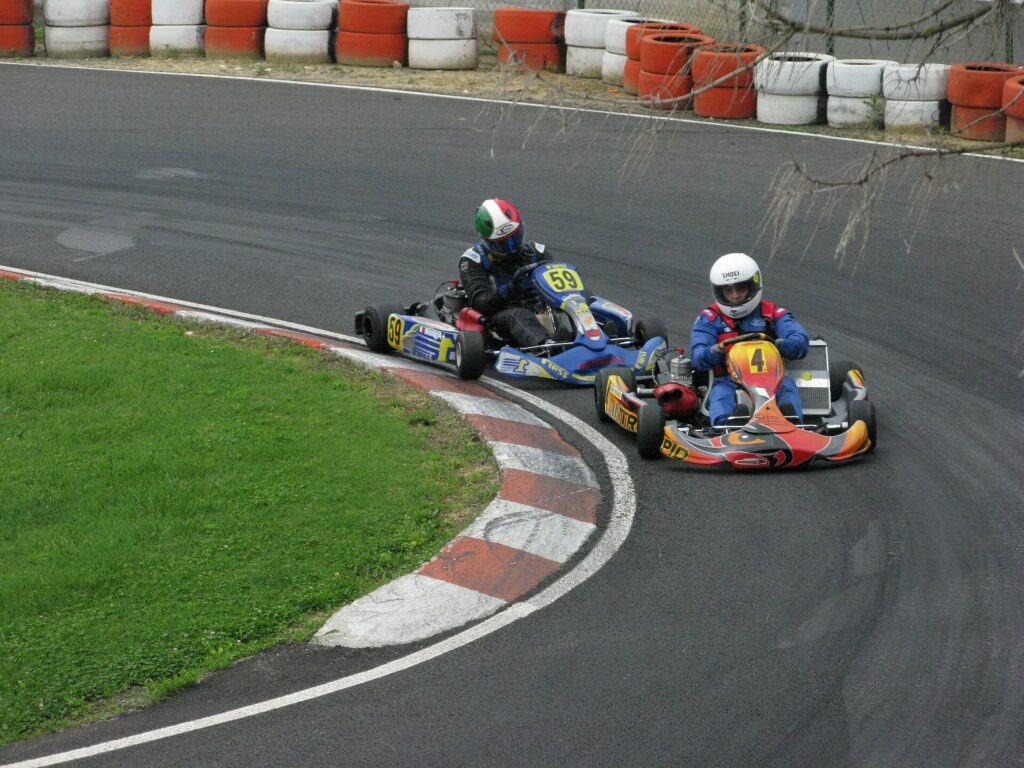
Then there is braking: learning to brake late and hard. And the steering inputs. You have to be nice and smooth, because the steering of a kart is so much more sensitive than a normal road car. You use very few degrees of steering wheel compared to what you do on the road.
That is pretty much similar between rental karts and owner karts. But the owner karts are much more responsive. The setups are stiffer, the frames are stiffer, the karts are lighter and more powerful. So you need even less steering.
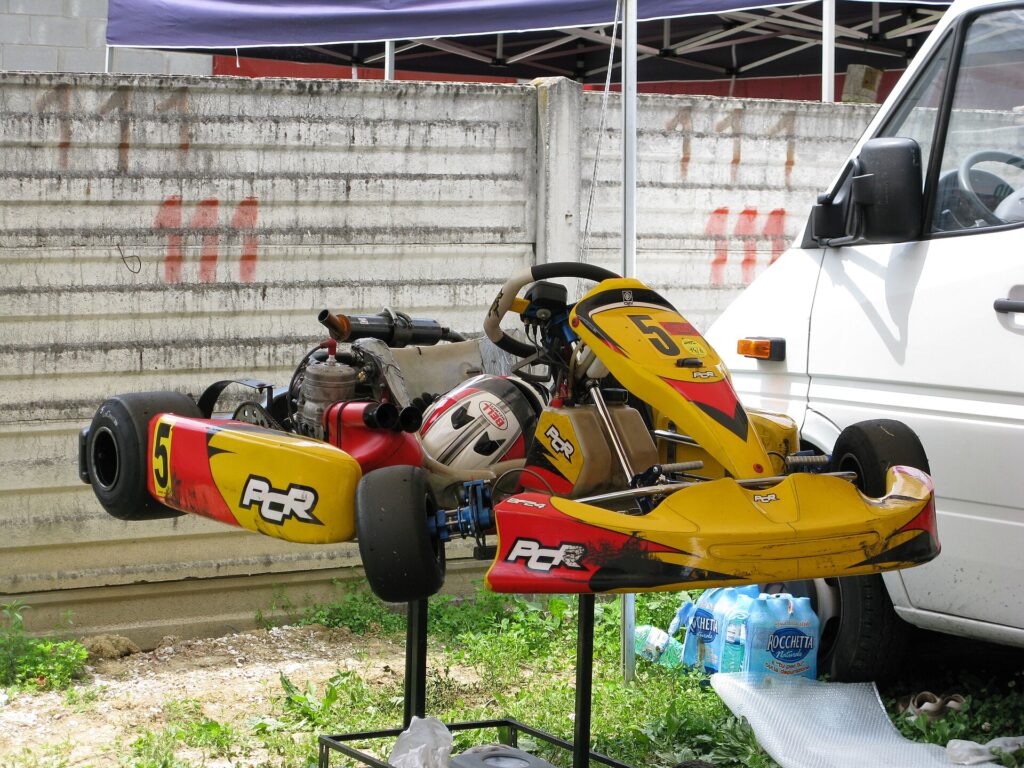
So rental karting is still a very good way to learn all the basic driving techniques you will need to go fast in owner karts.
When does rental karting stop helping you progress?
If your end goal is to become a professional karting driver, or to race formulas or GTs, at some point you will have to transition into owner karts.
Because rental karts have a limited cap, in my opinion. The speed is pretty low. The weight is quite high. The G-forces are not that high. So at some point, I believe, you are going to plateau your development if you stick to driving rental karts.
So when is the moment?
Once you are able to consistently win or drive very fast lap times on the rental karts, and you always feel like you would like a faster kart, you would like to get faster in the corners, that’s the moment I think you’re ready to transition into professional karts.
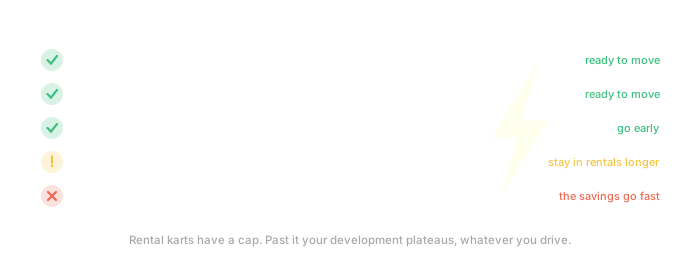
Just be aware that the costs are going to be much higher. So you need to be ready to use up a bit of your savings.
This page is about the when and the why. For the move itself, I cover it in how to transition from rental karts to professional kart racing.
What changes in your driving technique in an owner kart?
The major difference is speed. How much more depends on which category you choose to drive. And with higher speeds come longer braking distances.
So braking efficiency matters even more in professional karts than in rental karts.
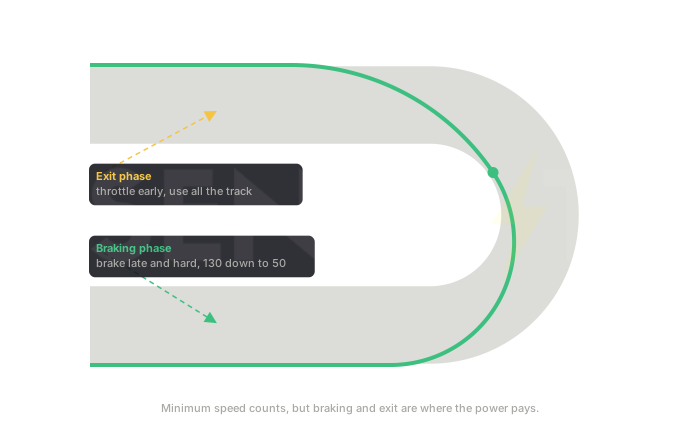
In a rental kart you may brake for just 10 or 15 meters, because maybe you go from 50 km/h top speed to 35 km/h minimum speed to make a hairpin. In a professional kart you may go from 130 km/h all the way down to 50 km/h for a hairpin.
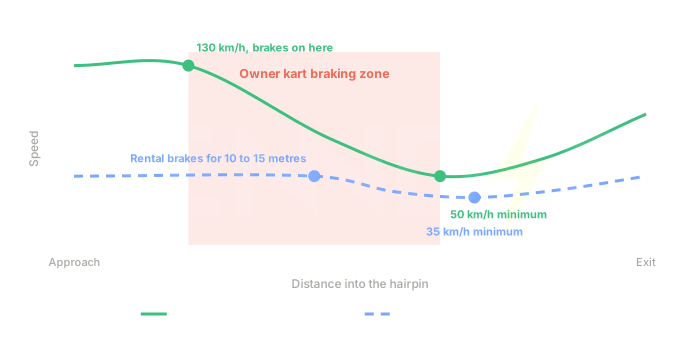
So you have to slow down by about 80 km/h. That is a very hard braking, for a longer time than on an average rental track. Braking technique is the thing that gets tested a lot more.
The grip level is higher too, so you have to be even smoother with the steering. The racing lines are important as well, but again, that’s pretty equal between the two.
And the power is quite a lot higher. So getting on the throttle at the right time, using up the track properly and taking advantage of the exits is very, very important. The minimum speed still matters. But the major bits are in the braking phase and in the exit phase of the corner.
And if you are already in an owner kart, send me your onboard. I go through your braking and your exits corner by corner in an onboard review and I tell you where the time is.
How much faster is a racing kart than a rental kart?
It depends on the track length, of course. But let me give you one I know well.
Take a 1,200 meter track like South Garda Karting in Lonato, where we normally do 46 to 47 second lap times with senior karts, or even with junior karts. In a rental kart you would be at least 20 seconds slower.
So there’s a significant speed difference. Juniors and seniors reach 135 to 140 km/h on that track. Rental karts, I believe, reach up to about 75 km/h.
You will feel so slow when you go back to a rental kart. But they are not built for performance. They are built more for fun.
And if it is 20 seconds over a lap, you can imagine over a race distance.
(South Garda is one of the circuits in my list of the best karting tracks in Italy.)
What do people misunderstand about racing karts?
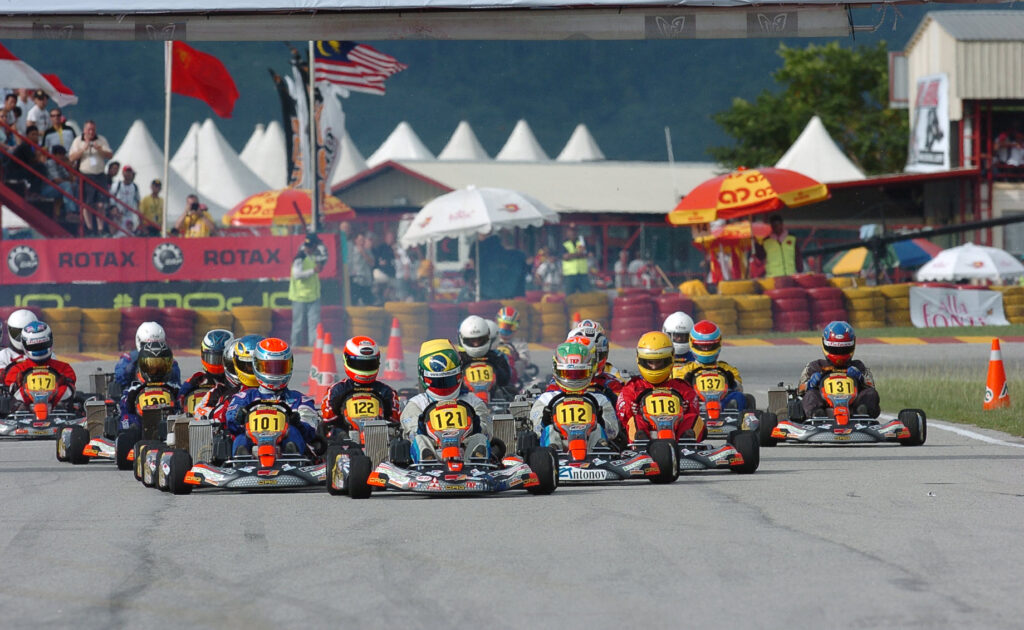
The thing people misunderstand the most is that they think it’s not a physical sport. Racing karts are actually very physical.
Your heart rate sits at about 170 to 180 BPM for 15 to 20 minute sessions. That is a proper workout. Part of it is the adrenaline, which shoots your BPM up. And part of it is that it’s a very high cardio exercise, where you work with your full body.
Your legs, your core, your neck, your chest, your forearms. So you need great stamina to not get tired too soon. I go deeper into that in my guide to karting fitness.
Racing karts are also very agile. They basically sit on the ground, and the power to weight ratio is pretty high because they are so light: about 150 kilos including the driver, with 40 to 50 horsepower. So there’s a lot of acceleration.
But the most important thing is the G-forces. You get up to 2.5 G laterally in the corners. And bear in mind you have no seat belts, and you’re literally sitting on the ground. Especially if you’re a tall driver and you have to sit very low.
The other misunderstood thing is the level. People believe it’s just a hobby. But it’s a proper sport, with people putting their lives and their passion into it.
What kind of driver should stay in rentals longer?
For sure, rental karts are a good option for drivers on a low budget. Maybe they are still at school, or they are working at a job, and they don’t have that much free time or that much spare money to spend on karting. Sticking to rental karts is probably the best choice. (If that is you, see the cheapest way to start kart racing.)
And some drivers don’t necessarily want the high performance, high competition level of karting. It is really, really exciting for some. But it can be quite demanding for others.
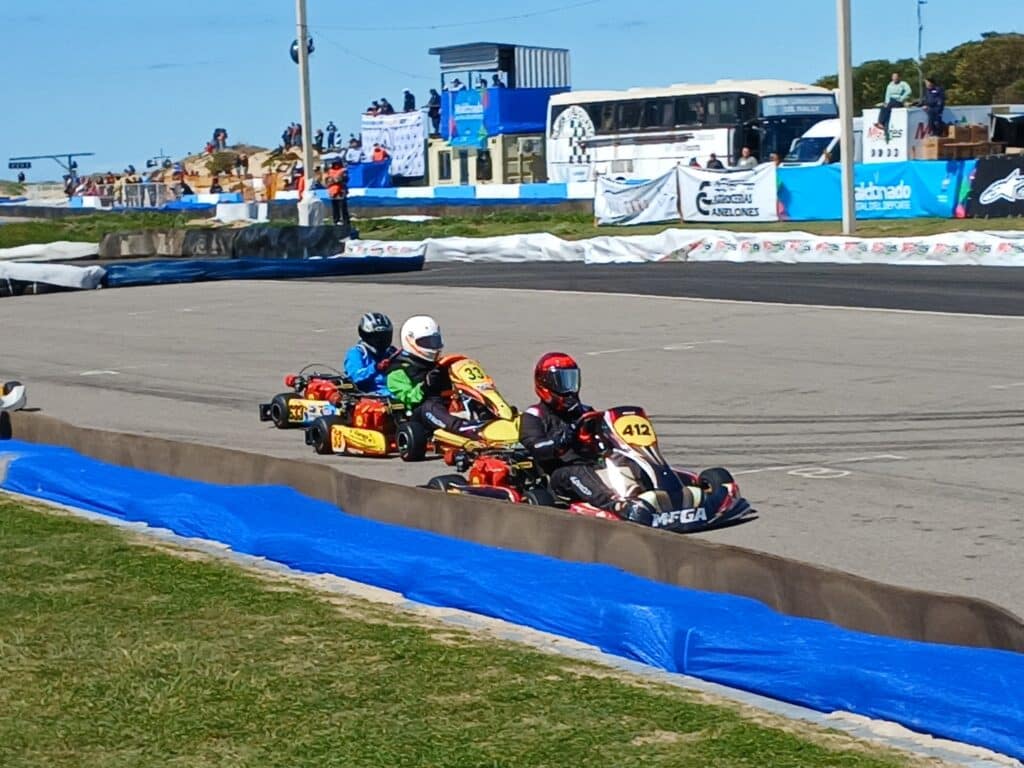
For those drivers, and even for kids starting out, I believe it is a good thing to stay a bit longer in rentals. It depends a lot on the budget, on the time commitments, and sometimes on school.
What kind of driver should move early to owner karting?
The drivers who are committed and motivated, who have the budget to spend and the time to allocate. And the drivers who overall feel like they need to level up.
They want to go faster. Those are the drivers I would recommend go into owner karts early.
And if you wish to win lots of races and make a name for yourself internationally, then you should make the switch early.
How much more does owner karting cost than rental karting?
A lot more. Let me put my numbers next to each other.
In rentals you can spend up to 25 euros per session of 15 minutes. If you do that four times per month, that is a max of 100 euros per month. About 1,200 euros per year.
Then there is the serious rental approach. A local race every week and driving two or three times per week. That may cost you 150 to 200 euros per week, so about 7,000 to 9,000 euros per year. That is if you try to become the best rental kart driver of your country, I would say.
In owner karting you buy the kart first. And then every day at the track costs you. The entry ticket is about 70 euros. Fuel for a day is about 50 euros. One set of used tires is about 50. So about 170 euros per day, and that is supposing you do the mechanic yourself.
| What | Rental karting | Owner karting |
|---|---|---|
| To get started | Nothing to buy | 2,000 to 4,000 euros for a first kart with engine, plus your equipment |
| One outing | About 25 euros for 15 minutes | About 170 euros for a practice day with used tires and no mechanic |
| Driving for fun, once a week | About 1,200 euros per year | Depends on the program |
| Racing every week | About 7,000 to 9,000 euros per year | Depends on the program |
I leave the owner side open on purpose, because it depends a lot on the program you choose. I go through it tier by tier in how much karting costs per year.
What hidden costs exist in owner karting that people don’t expect?
There are many. Besides getting your own kart, people need to understand that you have to pay your mechanic.
Professional karts are complicated enough that maintenance is high. You either learn how to do it yourself, which takes time, or you pay somebody. And even if you know how to do it yourself, you may still want a mechanic to help you.
- A mechanic: normally between 200 and 250 euros per day
- New racing tires: about 250 euros a set
- Used tires: about 50 euros a set, with less performance and less grip
- Engine maintenance: the piston, the piston rings
- Kart maintenance: bearings, axles, stub axles
The mechanic is not mandatory. But if you want to have everything really high performing, a very experienced mechanic makes a big difference.
Same with the tires. If you want really high performance you need new tires. But not necessarily. If you’re just casually testing and training, you don’t need to set the track record.
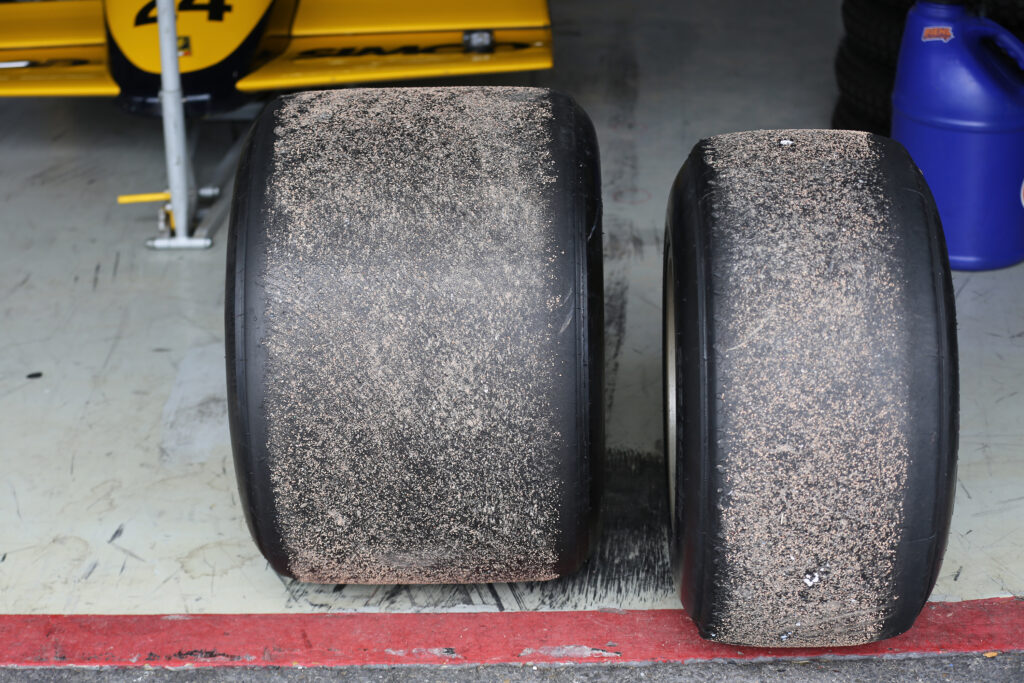
And then the engine. It is the thing that requires the most maintenance on the kart. So getting an engine like an IAME X30 or a Rotax is going to give you better value for your money, because it requires less maintenance.
If your budget is limited, where should the money go first?
For sure, into getting yourself up and running in rental karts. Spend a lot of days driving and understanding the basic driving technique. Watch onboard videos, take some courses, get coached. Get the basics of karting first.
Then once you are very fast on the rental kart, you step up.
And in that moment you need to expect to go from 25 euros for 15 minutes to between 2,000 and 4,000 euros right out of the gate, if you want to buy a kart for yourself, engine included. The engine is a large portion of that. About 50% of the spend, I guess, depending on which engine you go for.
That is to get started. A kart that is supposed to be used for races costs more: about 2,500 euros for the chassis alone and about another 2,500 for the engine.
If you are still not sure whether you want to do it or not, I would go with a used kart rather than a new one. It is a minor risk compared to buying a brand new kart. I explain what to check in used vs new kart: what to buy first.
Once you have your own kart, you deal with the track tickets, fuel, maintenance, mechanic and tires.
And then the equipment. In rental karts you don’t need any. In owner karting you do: your own helmet, rib protector, race suit, race boots and race gloves. Here is the full kit list.
Do you have to start in rental karts before buying your own kart?
No. I started immediately in owner karting, because I was introduced by my father, who was a pro karting driver himself.
But I see lots of drivers nowadays who start with rental karts for the first year of their experience. And they are also very successful. So I totally believe you can be successful with both approaches.
Still, I feel that starting with rental karts is always a good decision. They are cheaper. And they are safer, in a way that you can try and test the limits, and even if you crash you basically have no damage. You have side, front and rear protections. And the speed is very low, so you can test the limits without getting afraid.
Then once you get good at them, enjoy them and want to level up, you should definitely make the switch into proper racing karts.
The whole path is in how to start karting step by step.
Should you still drive rental karts once you own a kart?
If someone told me back in 2011 to go rental karting to increase my chances of winning, I would have laughed at him. No joke.
I’ve always had great fun with rental karts. On holiday, when I couldn’t drive my own kart. But I never thought they could be used to become a better driver.
Now I’m starting to change my mind. And when I say rental karting here, I mean indoor tracks. Because they are way more unforgiving. The walls, the narrow width, the tight corners.
The power is limited, so the engine won’t help to pull you out of the corners. If you mess up, you bog down and you lose a ton. And you notice it.
Also, it’s all on you. Not the chassis, not the engine, not the tires.
I first heard about this from English teams taking mechanics and drivers to rental karts, to teach them a thing or two about racecraft.
And it costs a fraction. A 30 minute session at your local indoor track after school, spending what? 40 euros?
But I’m not here to suggest you swap testing with indoor rental karts. The full program on the real track is still way more important. Some rental karting here and there is a good add-on. I wish I did it more, to be honest.
More on that in indoor karting vs outdoor karting.
Rental or owner: which one is right for you?
Stay in rental karts if your budget or your free time is limited, or if you are driving for fun. You still learn racing lines, braking and smooth steering, and all of it carries over.
Move to owner karts once you are consistently winning or setting very fast lap times in rentals and you keep wanting a faster kart. Go in knowing it is a lot more physical, about 20 seconds a lap faster at a track like Lonato, and a lot more expensive once you add the mechanic, the tires and the maintenance.
It depends on your financial situation and on your time. Whatever you choose, I hope you have some fun and build a passion around it.
You find the rest of what I wrote for drivers starting out in the beginner guides.
And if you already drive, rental or owner, and you want me to look at how you drive, there is the onboard review and there is the 6 months transformation.
Frequently asked questions
Is owner karting faster than rental karting?
Yes, by a lot. At South Garda Karting in Lonato, a 1,200 meter track, senior karts lap in 46 to 47 seconds and a rental kart would be at least 20 seconds slower. Juniors and seniors reach 135 to 140 km/h there, and rental karts reach up to about 75 km/h.
Can you learn to race in rental karts?
Yes. Racing lines, braking late and hard, and smooth steering inputs are the same in a rental kart and in a racing kart. What rental karts do not give you is the speed, the grip and the G-forces, so at some point your development plateaus.
How much does it cost to buy your own kart?
Expect between 2,000 and 4,000 euros for a first kart including the engine, with the engine being about half of it. A kart meant for racing is about 2,500 euros for the chassis and about another 2,500 for the engine.
Do you need your own equipment for rental karting?
No. At a rental track they provide everything. With your own racing kart you need your own helmet, rib protector, race suit, race boots and race gloves.
Do you need a mechanic in owner karting?
It is not mandatory. A mechanic normally costs between 200 and 250 euros per day, and you can learn to do the maintenance yourself, which takes time. If you want everything performing at a really high level, a very experienced mechanic makes a big difference.
Send your onboard footage. Alessio reviews it corner-by-corner and tells you exactly what's costing you time, and how to fix it. Back within 48 hours.
Get My Onboard Reviewed → Reviewed personally by a CIK FIA World Champion, never an assistant.I promise I'll not spam you with repurposed shitty AI content but real experiences that only I, Alessio Lorandi, experienced. Written in my funny English-Italian tone of voice 😂
Alessio Lorandi is the former CIK FIA World Junior Champion, winning against Lando Norris in 2013 & F3 multiple race winner. He's helped 200+ karting drivers worldwide get faster & win WSK titles with BabyRace Driver Academy & now through Senndit, his online karting coaching platform.